
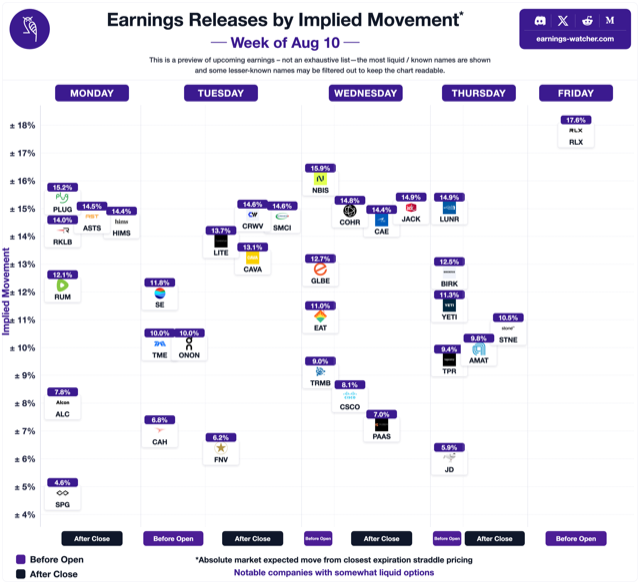
The expected move (or implied move) is how big a swing the options market prices in for an earnings report. Whether a stock “beats” it — moves more than priced in — varies widely. In our July 2026 sample, beat rates range from about 25% (NVDA, KO) to ~88% (UNH). The key takeaway: being a big mover is not the same as beating the implied move. NVIDIA moves a lot yet usually lands under what options priced in; UnitedHealth and IBM clear it far more often.
Expected move vs. beat rate, by stock
| Stock | Avg move (10yr) | 95th-pct tail | Beats implied move |
|---|---|---|---|
| UNH UnitedHealth | ±5.7% | ±10.6% | 88% (14 of 16) |
| IBM IBM | ±7.0% | ±12.0% | 81% (13 of 16) |
| MS Morgan Stanley | ±4.6% | ±8.2% | 81% (13 of 16) |
| ABBV AbbVie | ±5.7% | ±10.4% | 75% (12 of 16) |
| AXP American Express | ±4.9% | ±9.8% | 75% (12 of 16) |
| SLB Schlumberger | ±4.6% | ±9.3% | 75% (12 of 16) |
| INTC Intel | ±9.7% | ±18.2% | 69% (11 of 16) |
| CHTR Charter | ±8.8% | ±19.1% | 69% (11 of 16) |
| NKE Nike | ±8.8% | ±15.7% | 69% (11 of 16) |
| META Meta | ±11.8% | ±25.8% | 63% (10 of 16) |
| AMD AMD | ±10.7% | ±21.2% | 63% (10 of 16) |
| GM General Motors | ±6.2% | ±11.2% | 63% (10 of 16) |
| ASML ASML | ±5.8% | ±11.2% | 63% (10 of 16) |
| JPM JPMorgan | ±3.4% | ±6.1% | 63% (10 of 16) |
| PYPL PayPal | ±9.3% | ±14.7% | 62% (10 of 16) |
| CVX Chevron | ±3.7% | ±6.3% | 62% (10 of 16) |
| AMZN Amazon | ±7.4% | ±13.7% | 60% (9 of 15) |
| TSM TSMC | ±4.9% | ±10.1% | 60% (9 of 15) |
| NFLX Netflix | ±10.5% | ±20.1% | 56% (9 of 16) |
| TSLA Tesla | ±9.3% | ±16.3% | 56% (9 of 16) |
| GOOGL Alphabet | ±6.5% | ±10.3% | 56% (9 of 16) |
| BA Boeing | ±5.4% | ±10.1% | 56% (9 of 16) |
| PG Procter & Gamble | ±3.8% | ±6.6% | 56% (9 of 16) |
| MSFT Microsoft | ±5.0% | ±9.4% | 50% (8 of 16) |
| V Visa | ±3.7% | ±10.3% | 50% (8 of 16) |
| AAPL Apple | ±4.9% | ±8.1% | 44% (7 of 16) |
| ARM Arm Holdings | ±14.2% | ±64.4% | 36% (4 of 11) |
| NVDA NVIDIA | ±8.3% | ±20.1% | 25% (4 of 16) |
| KO Coca-Cola | ±2.9% | ±4.9% | 25% (4 of 16) |
How to read it. “Avg move (10yr)” is the typical earnings-day peak move over roughly the last decade. “95th-pct tail” is the realistic worst-case move. “Beats implied move” is how often the actual move exceeded the options-implied move — the figure that decides whether option buyers or sellers had the historical edge. Tap any ticker for its full playbook.
What the data shows
- High volatility ≠ high beat rate. NVIDIA averages a large ±8.3% move but beats its implied move only ~25% of the time; the premium is usually rich enough to cover it.
- Banks and healthcare can clear implied often. UNH (~88%), MS (~81%) and JPM (~63%) show that low average moves can still beat what options priced in.
- Mega-caps often move less than implied. Apple (~44%) and NVIDIA (~25%) have historically come in under the implied move more often than not.
- Beat rate says nothing about direction. It only measures move size versus what was priced — not whether the stock went up or down.
Why the expected move and beat rate matter
Going into a report, implied volatility — and option prices — climb (the IV rush), then collapse the morning after (the IV crush). A stock’s beat-rate history is the cleanest way to gauge whether that rich pre-earnings premium has tended to be worth paying. It is a reference point, not a signal: the live implied move versus a stock’s own history is what matters each quarter.
Per-stock earnings playbooks
Full move history, distribution and IV behaviour for each name:
- UnitedHealth (UNH) earnings options
- IBM (IBM) earnings options
- Morgan Stanley (MS) earnings options
- AbbVie (ABBV) earnings options
- American Express (AXP) earnings options
- Schlumberger (SLB) earnings options
- Intel (INTC) earnings options
- Charter (CHTR) earnings options
- Nike (NKE) earnings options
- Meta (META) earnings options
- AMD (AMD) earnings options
- General Motors (GM) earnings options
- ASML (ASML) earnings options
- JPMorgan (JPM) earnings options
- PayPal (PYPL) earnings options
- Chevron (CVX) earnings options
- Amazon (AMZN) earnings options
- TSMC (TSM) earnings options
- Netflix (NFLX) earnings options
- Tesla (TSLA) earnings options
- Alphabet (GOOGL) earnings options
- Boeing (BA) earnings options
- Procter & Gamble (PG) earnings options
- Microsoft (MSFT) earnings options
- Visa (V) earnings options
- Apple (AAPL) earnings options
- Arm Holdings (ARM) earnings options
- NVIDIA (NVDA) earnings options
- Coca-Cola (KO) earnings options
Frequently asked questions
What is an expected (implied) move on earnings?
The expected move — also called the implied move — is how big a price swing the options market is pricing in for an upcoming earnings report. It is derived from option prices (roughly the cost of the at-the-money straddle for the expiry covering the report) and only firms up in the days before earnings. It is the market's one-standard-deviation estimate of the post-earnings move, not a prediction of direction.
Which stock beats its implied move most often?
In our expanded sample (as of July 2026), UnitedHealth has one of the highest beat rates at about 88% (14 of 16). IBM and Morgan Stanley sit near 81%. Among Mag 7-style names, AMD and Meta remain near 63%. NVIDIA is still among the lowest at about 25% — a large mover that usually lands under what options priced in.
Do stocks usually move more or less than the implied move?
It varies by stock and there is no universal rule. Several mega-caps (Apple ~44%, NVIDIA ~25%, Coca-Cola ~25%) have historically moved less than their implied move more often than not; higher beat-rate names like UNH, IBM and Meta clear it more often. Compare each quarter's live implied move against that stock's own history.
How is the expected move calculated?
It is read from the options market: a common approximation is the price of the at-the-money straddle (call + put) for the nearest expiry after the report, expressed as a percentage of the stock price. Because it depends on live implied volatility, it changes constantly and is only meaningful in the window before an earnings date.
How should I cite this data study?
Suggested citation: EarningsWatcher Research, “Earnings Expected Moves: Who Beats the Implied Move,” updated July 2026, https://earnings-watcher.com/wiki/earnings-expected-moves. Please link the URL so readers can see the live table and methodology.