
Implied volatility rises before earnings because an earnings report is a scheduled spike in uncertainty. Traders don't know whether the stock will jump or fall on the news, so they buy options to hedge and speculate — and sellers charge more to take the other side. That extra demand, plus the market pricing in a one-day jump that hasn't happened yet, pushes implied volatility (and option premiums) steadily higher as the date approaches. This pre-earnings build-up is the IV rush, and it reverses violently once results are out (the IV crush).
What is IV rush?
IV rush is the rise in implied volatility in the days and hours before an earnings release. As traders hedge and speculate, demand for options increases, lifting IV and option premiums.
Why does implied volatility rise before earnings?
Three forces push IV up into a report:
- Event uncertainty. Earnings can move a stock far more than a normal day, so options price in that expected jump and the volatility input climbs.
- Demand for protection and speculation. Holders buy puts to hedge, speculators buy calls and puts for the move; more buyers than sellers lifts option prices, which shows up as higher implied volatility.
- A volatility risk premium. Option sellers know the post-earnings move is uncertain, so they demand extra premium to take the other side of that risk.
The rise usually accelerates in the last days and hours before the release and is concentrated in the nearest expiration that captures the event; longer-dated expirations move much less.
- Happens into the event, not after it.
- Typically strongest in the nearest expiration that contains the earnings move.
- Inflates the implied move quoted by the options market.
How much does implied volatility rise before earnings?
There is no single number — the size of the IV rush depends on the stock, the expiration and how the market feels about the report. It is generally larger for stocks with a history of big earnings moves and for the nearest expiration that captures the event, and it tends to accelerate in the final days and hours before the release. The clearest way to gauge the typical expansion for a given name is to look at its own history rather than a rule of thumb: EarningsWatcher charts how a stock's implied volatility and implied move have behaved into past reports, and the implied-move beat-rate study shows how often names actually move as much as that premium suggested.
Does implied volatility rise before earnings and fall after?
Yes — that round trip is the entire earnings volatility cycle. Implied volatility climbs into the report (the IV rush), then drops sharply on the first session after results are out, because the uncertainty that justified the premium is gone. That post-earnings collapse is the IV crush.
IV rush: the rise in IV before earnings, as demand and event premium build into the report.
IV crush: the sharp reset lower in IV on the first session after the release, once the uncertainty is resolved.
Because the rush happens before the print and the crush happens after, the two are the opposite halves of the same event — one inflates option premium, the other deflates it. Reading both is what separates an informed earnings options decision from a guess.
How pre-earnings IV affects option prices
- As IV rises, option premiums increase across calls and puts.
- The at-the-money straddle (call + put) becomes more expensive, so the implied move widens.
- Because the move hasn’t happened yet, that added premium is pure expectation — it is exactly what the post-earnings IV crush later removes.
What makes the IV rush bigger or smaller
The size of the pre-earnings build-up is not the same for every stock or every quarter. It tends to be larger when:
- The stock has a history of large earnings moves, so the market prices in a wider jump.
- You look at the nearest expiration that contains the report — front-week options carry almost all of the event premium, while longer-dated options barely move.
- There is extra uncertainty around the print — a new product, a guidance question, or a volatile market backdrop.
It is smaller, or even muted, when IV is already elevated for other reasons or when the market simply does not expect much from the report. Comparing the current rush to a stock's own history is far more useful than any fixed rule — the implied-move beat-rate study shows how differently names behave around their own implied move.
How EarningsWatcher models the IV rush
The IV Rush Radar doesn't guess how implied volatility will behave into a report — it measures how it has behaved, name by name. The method: for every tracked stock, the Radar records at-the-money IV from the nearest expiration covering the report, twice a day across the final five sessions before each earnings print. Stack enough reports and you get two things: the name's median ramp path — its typical pre-earnings IV signature — and a live overlay showing where the current cycle sits against that history, updated through the day.
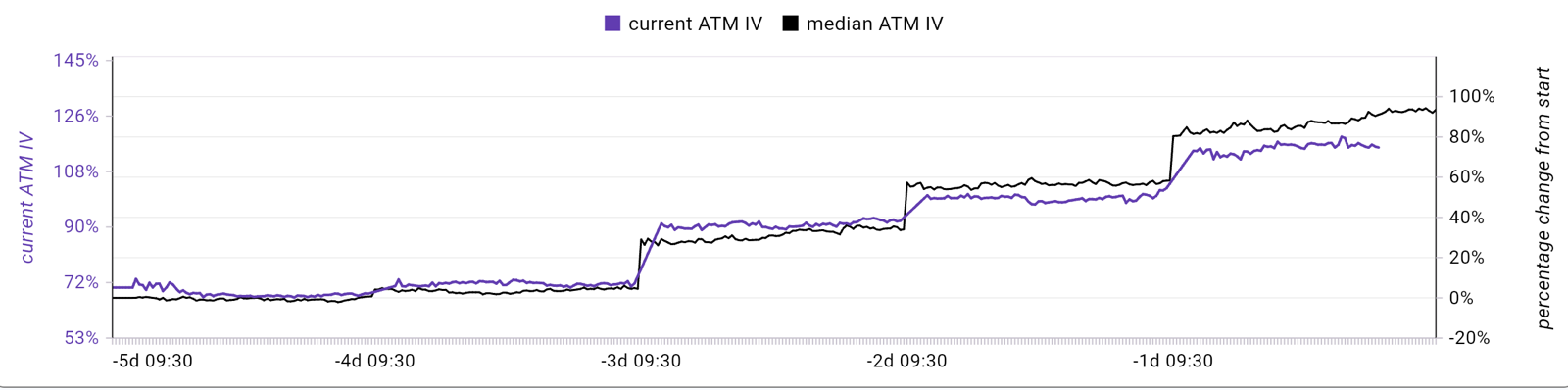
Reading it is the whole read: when the purple line runs below the black one, the rush is lagging the name's own history — when it runs above, the ramp is already rich. That context is what turns "IV usually rises before earnings" from trivia into an entry and an exit.
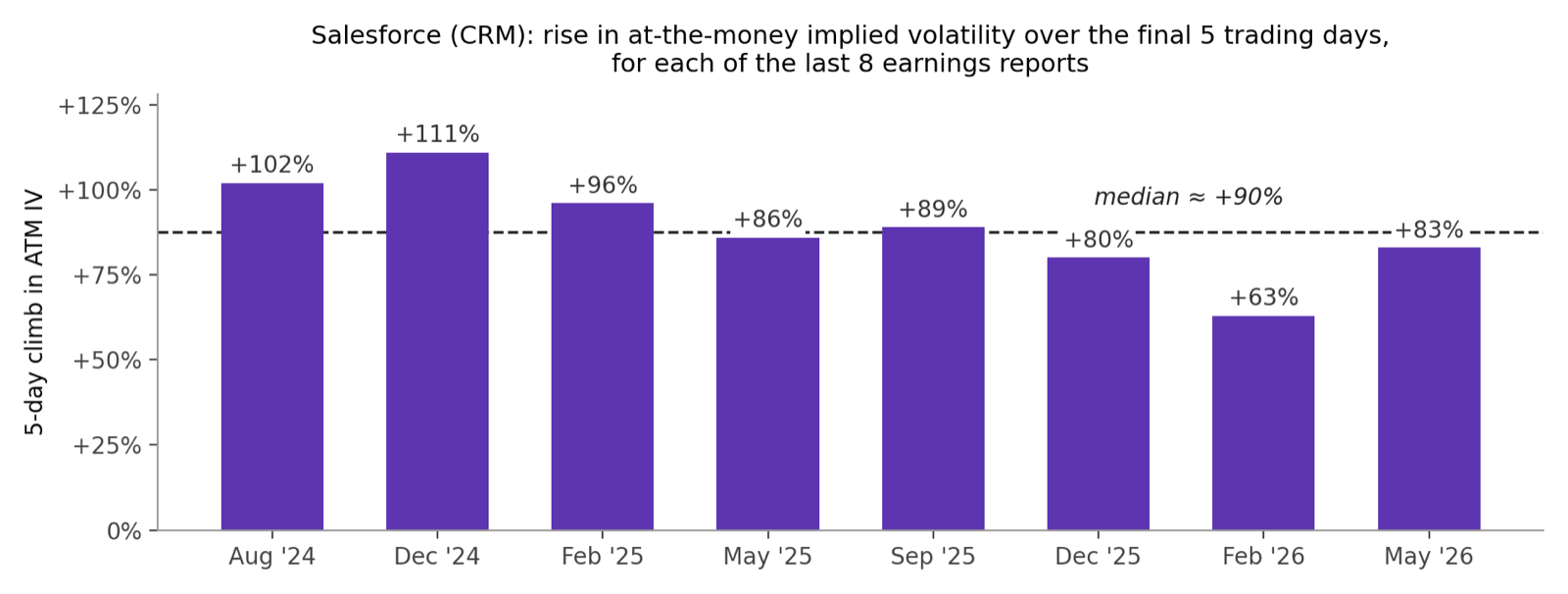
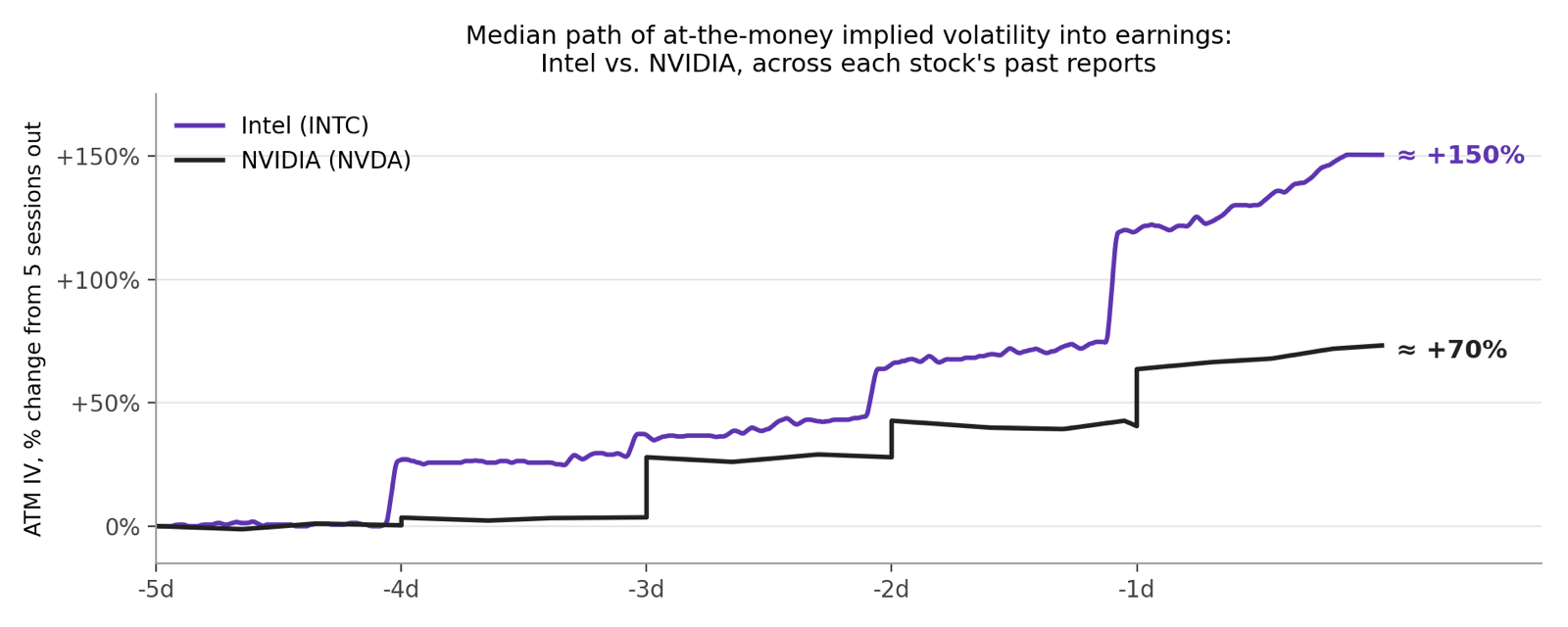
And the pattern is personal to each name — which is why a single rule of thumb fails:
Want the full loop in practice? A member case study walks IV Rush research → paper trade → journal using EW MCP in chat: MCP member trading OS.
Common misconceptions about IV rush
- “IV always rises before earnings.” Usually it does, but the size varies a lot and can be small when IV is already high.
- “A bigger rush means a bigger move.” Not necessarily — the rush reflects expected uncertainty and the volatility risk premium, not a predetermined outcome. History shows many names move less than their implied move.
- “The rush is the same across expirations.” It is concentrated in the front expiry that contains the event; longer-dated IV moves far less.
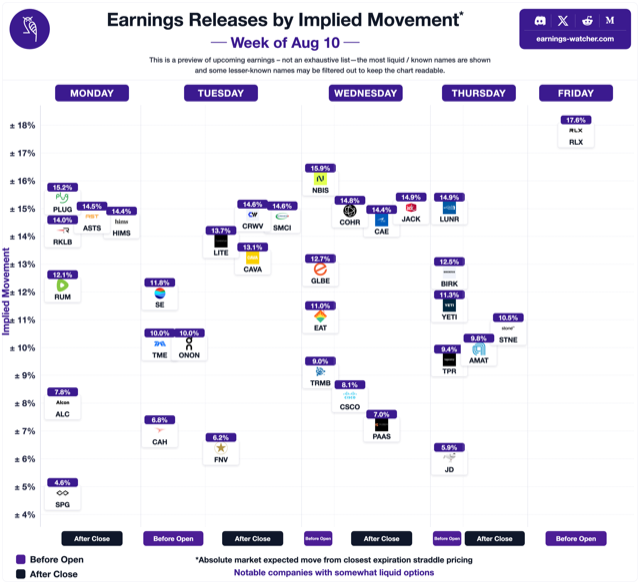
Related: unusual options activity — the trade-level flags whose aggregate effect is the IV rush this page describes.
See which names are on the IV Rush Radar right now, with each stock’s typical last-day IV ramp into earnings.
Frequently asked questions
Why does implied volatility rise before earnings?
Implied volatility rises before earnings because the report is a scheduled spike in uncertainty. Traders buy options to hedge and speculate on the move, and option sellers demand extra premium for the event risk. That added demand and event premium push implied volatility — and option prices — higher as the date approaches. This build-up is called the IV rush.
Does implied volatility increase the day before earnings?
Yes. Implied volatility usually keeps rising into the report, and the increase tends to accelerate in the final days and hours before the release, especially in the nearest expiration that captures the earnings move. Longer-dated options move much less.
How is IV rush different from IV crush?
IV rush happens before earnings and inflates premiums as the event approaches. IV crush happens immediately after the release, when implied volatility collapses and premiums deflate. They are the two halves of the earnings volatility cycle.
Can implied volatility go up after earnings?
Usually it falls sharply (the IV crush) once the event uncertainty is resolved. It can rise after earnings only if a new source of uncertainty appears — an investigation, surprise guidance, a follow-on event, or a broad market volatility spike — but the typical earnings reaction is a drop in implied volatility.
Does implied volatility always rise before earnings?
Most of the time implied volatility rises into a scheduled report, but not always to the same degree. The build-up can be muted when implied volatility is already elevated for other reasons, or when the market expects little from the print. The reliable way to know is to compare the current level against the stock’s own earnings history rather than assuming a fixed pattern.