
What is the earnings implied move?
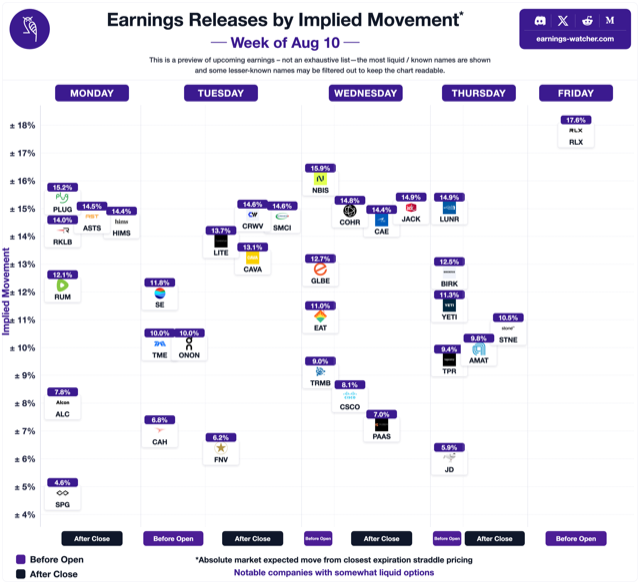
The implied move is the market’s estimate of how far a stock might move around earnings, based on option prices. It’s usually expressed as a percentage move up or down from the current price.
For earnings, traders usually look at the nearest expiration that contains the first trading session after the release (depends on whether the report is AMC or BMO).
Quick way to calculate implied move
A common rule of thumb is the at-the-money (ATM) straddle:
- Pick the expiration that includes the first full trading session after earnings.
- Find the ATM call and ATM put (closest strike to current stock price).
- Compute:
(call price + put price) ÷ stock price.
Example: stock at $100, ATM call = $6, ATM put = $5:
(6 + 5) ÷ 100 = 0.11 → 11% implied move.
Why the implied move matters for earnings
- It marks roughly where the market is pricing the breakevens on a straddle.
- It’s a simple yardstick to compare against the stock’s historical earnings moves.
- It frames the central question of any earnings options position: will the actual move end up bigger or smaller than what's priced in?
Implied move vs. historical earnings moves
Looking at implied move in isolation isn’t enough. You want to see it in context:
- Average past earnings move (absolute %).
- Standard deviation of earnings moves (how wide the range is).
- Percentiles of past moves (e.g., 50th, 80th, 90th).
If the current implied move is, say, 7%, but the stock has a history of 12–15% earnings moves with fat tails, that’s a very different setup than a sleepy name where 4–5% is already large.
How EarningsWatcher helps with implied move
1. Moves Analyser
Moves Analyser shows the distribution of past earnings moves so you can immediately see:
- Average and median earnings move.
- Standard deviation and tails.
- How the current implied move stacks up against history.
2. Simulator
The Simulator lets you plug in any structure (straddle, strangle, inverse butterfly, etc.) and see:
- How that position behaves across different stock moves from −X% to +X%.
- How IV crush by strike and expiration affects P/L around the implied move.
- Realistic risk/reward if the actual move ends up inside or outside the implied range.
How the implied move is read in practice
On its own the implied move is just a number; its meaning comes from context. The two situations traders distinguish are:
- Implied move modest vs history. When the priced-in move is small relative to the stock's past earnings moves, the market is pricing relatively little — the setup leans toward the long-volatility side of the ledger.
- Implied move rich vs history. When the priced-in move is large relative to history, options are expensive going in, and the IV crush after the report tends to dominate.
Note the framing is descriptive, not a recommendation: it describes what the data shows, and any position still carries the full risk of an outlier move in either direction.
Common mistakes when calculating the implied move
- Mixing expirations — using the wrong expiry relative to the earnings date (AMC vs BMO).
- Forgetting that IV crush hits different strikes and expiries differently, so the straddle proxy is an approximation.
- Ignoring liquidity and bid/ask spreads when reading prices right at the at-the-money strike.
Frequently asked questions
What is the implied move for earnings?
The implied move is the percentage move the options market is pricing in for an earnings event. A quick proxy is the at-the-money straddle price (ATM call + ATM put) divided by the stock price, using the expiration that contains the first post-report session.
How do you calculate the implied move?
Add the price of the at-the-money call and the at-the-money put for the nearest expiration covering the report, then divide by the stock price. For example, a $5 straddle on a $100 stock implies roughly a 5% move.
How do you use the implied move when looking at earnings?
Compare the implied move to the distribution of the stock's past earnings moves. A move priced small relative to history reflects long-volatility dynamics; priced large, the IV crush after the report tends to dominate. This is descriptive context, not a trade recommendation.