
Options are easiest to learn around earnings, because the event gives every idea a date. Implied volatility rises into the report and collapses after it; the stock makes one large move on a known day; the options market prices that move in advance and is measurably wrong about it in both directions. Every strategy below is a way of taking a position on one of those facts, and every one of them can be practised on a real week whose outcome is still hidden from you.
Before you start: three ideas
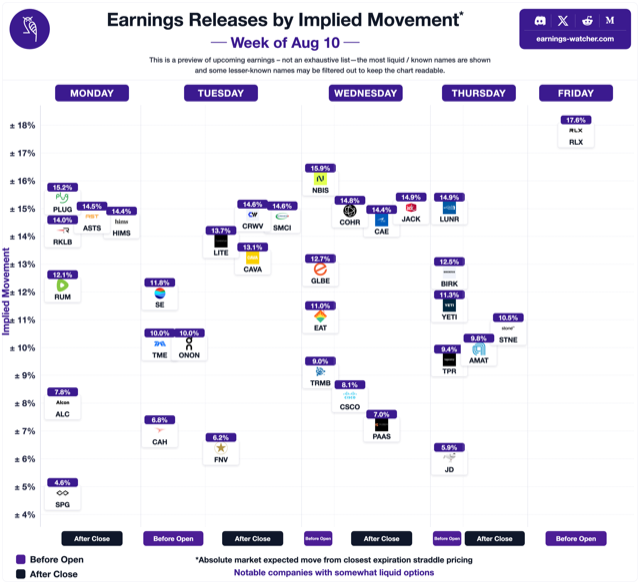
- The implied move — the size of the earnings move the options market is pricing in, read from the at-the-money straddle. Everything else is measured against it.
- IV rush and IV crush — implied volatility climbs into the report and collapses the next session. Buying options means paying for the rush; selling them means owning the crush.
- A stock's own history — how far each name has actually moved on past reports, and how often it beat what options had priced. Across 28,898 reports since 2023, only 25.2% closed beyond the implied move.
You can read all three in an hour. The rest of this page is practice.
Path 1 · Long volatility
The trade before the print, both directions at once.
You buy options on a company just before it reports — a call and a put together — and close them the next morning once the stock has moved. You win when the move is larger than what the options were charging for; you lose the IV crush when it is not. It is the simplest earnings trade to pick up and the clearest way to see what the implied move actually means.
Read
- Straddle vs strangle — the two shapes of the same idea, and what changes when you widen the strikes.
- Exiting long volatility — why the first session after the print is the whole trade.
- Should you hold options through earnings? — a worked example of what the crush costs.
- Long vol vs short vol on NVDA — the same print, both sides.
Play
Long Vol Basics in Rewind: one trade, step by step, on a real week — read the range, price the structure in the Simulator, check the likelihood, then fast-forward to the open. Three weeks, three ways to own the same move.
The first week is free.
Path 2 · Short volatility
Selling the move the market has already priced in.
The mirror image: you sell the priced-in move and keep the premium when the stock stays inside it. The win is smaller and more frequent; the loss, when the stock moves through your strikes, is the one to respect. Defined-risk shapes — the iron condor and iron butterfly — exist for exactly that reason.
Read
- Options selling around earnings — what you are paid for and what you are exposed to.
- Iron condor vs iron butterfly — the two defined-risk shapes, compared.
- Why selling calls into earnings is a trap — the asymmetry that undoes naked short calls.
- Options strategies around earnings — the whole family in one place.
Play
Short Vol Basics in Rewind: five weeks of selling volatility, one shape at a time, as much about the losses as the wins — until the shapes worth keeping are the ones you reach for.
The first week is free.
Path 3 · IV rush
The day before the print, in at noon, out before the bell.
Implied volatility does not jump on earnings day; it climbs in the days before, and historically the largest part of that climb comes on the last trading day before the release. The IV rush trade owns that day: a straddle or strangle bought around noon and closed before the close, before the print and before the crush. It is a small, repeatable trade, and a different shopping list from the other three.
Read
- IV rush before earnings — the pattern, the term, and the numbers behind it.
- IV rush vs IV crush — the two halves of the cycle, side by side.
- IV Rush strategy recap — how the approach has played out on the live platform.
- IV Rush Radar — which names reporting in the next two weeks show the pattern.
Play
IV Rush Basics in Rewind: five weeks of the same small trade — a watch list with the straddle, a list with the strangle, two weeks of picks, then your own way. Check the curve, price it, own the last day, out before the bell.
The first week is free.
Path 4 · Momentum
The trade after the print.
The report is out, the stock has gapped, and the question changes: does the move carry on or reverse? Post-earnings drift is one of the most studied patterns in the literature, and some names have a habit of running while others fill the gap. Momentum reads the gap and the habit, picks a side, and rides the reaction day — no implied band, no crush to pay for.
Read
- Post-earnings announcement drift (PEAD) — the pattern and the research behind it.
- What NVDA does after earnings — one name's follow-through and gap-fill history.
- Who beats the implied move? — cross-stock beat rates from ten years of prints.
Play
Momentum Basics in Rewind: three weeks of the trade after the print — a watch list from the calendar's drift columns, then the Runners, then your own way. Read the gap, check the habit in DriftLab, pick a side, and close it when it has run.
The first week is free.
Practising without real money
Rewind is an options trading simulator built on five real earnings weeks from 2026, from the bank week of July 13 to Nvidia week, August 24. Every screen is the EarningsWatcher platform with the clock wound back: the calendar, the implied moves, the option chains and the tools as they stood that morning, with the outcome hidden until you advance the clock. You trade with paper money, get scored, and move on to the next week. It runs in the browser and as an Android app; the iPhone version follows.
What is free: the first week of each guided game and two weeks of open play, with no ads and nothing to buy in the app. EarningsWatcher members get every week of every game and the live platform — the same tools on the weeks that have not happened yet.
Frequently asked questions
How do I learn options trading?
Start with three ideas — the implied move, the IV rush and crush cycle, and a stock's own earnings-move history — then practise one strategy at a time on real weeks with paper money. That is the order this page follows: a guide to read, a tool to look at, a game to play, for each of four strategies.
Can I learn options trading for free?
Yes. Every guide on this wiki is free, and Rewind, our options trading simulator, is free to start: the first week of each guided game and two weeks of open play, with no ads and nothing to buy in the app.
Is a simulator enough, or do I need real money?
A simulator on real historical data teaches the mechanics — pricing a structure, sizing it, closing it — without the cost of learning them live. It does not teach the feeling of real losses, and nothing here is a recommendation to trade real money.
How long does it take?
The four guided games are sixteen real earnings weeks in total, one week per session. Most people play a week in an evening. The open-play weeks and the live platform are where the practice continues after that.
This page is educational and does not constitute financial advice. Options involve risk and are not suitable for every investor. Rewind uses historical data and virtual money only; it does not execute trades or hold funds.