
When you expect an earnings report to move a stock sharply but you’re not sure which way, two of the most common structures are the straddle and the strangle. They’re close cousins — both are long volatility — but the strike choice changes the entire risk-reward profile.
How each one is built
- Straddle: buy a call and a put at the same at-the-money (ATM) strike, same expiration.
- Strangle: buy an out-of-the-money (OTM) call and an OTM put at different strikes, same expiration.
Side-by-side comparison
| Factor | Straddle | Strangle |
|---|---|---|
| Strikes | Same ATM strike | Two different OTM strikes |
| Cost (debit) | Higher | Lower |
| Breakevens | Closer to current price | Wider — needs a bigger move |
| Max profit | Unlimited (large move) | Unlimited (very large move) |
| IV crush exposure | High | High |
| Best when | You expect a big move and want tighter breakevens | You want low cost and the stock has huge-move history |
The earnings catch: IV crush
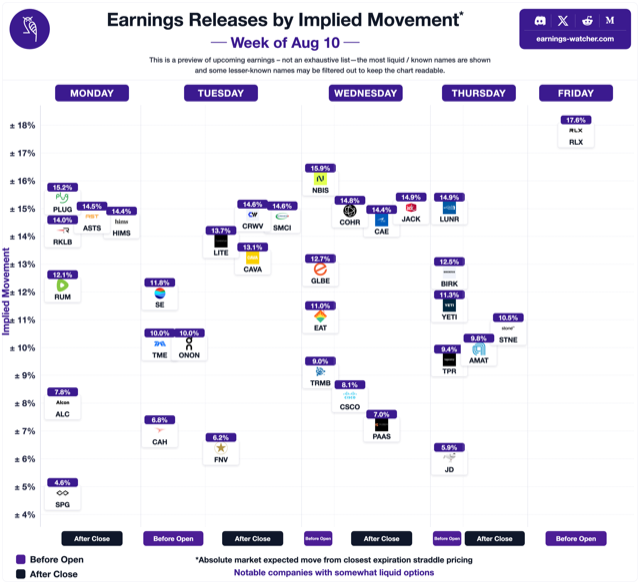
Because both are long premium, they’re exposed to IV crush — the collapse in implied volatility right after the report. To profit, the actual move must beat the implied move by enough to overcome that crush plus time decay. That’s why simply “buying a straddle into earnings” isn’t a free lunch: you’re paying up for elevated IV, and a merely average move often loses.
When to choose which
- Straddle — higher-conviction big move, want the tightest breakevens, accept higher cost and crush exposure.
- Strangle — want to spend less per trade, the name has a history of very large gaps, and you’re comfortable needing a bigger move.
- Neither, go defined-risk — if crush risk worries you, an inverse butterfly or condor can keep a long-vol thesis while cutting max loss.
Frequently asked questions
What is the difference between a straddle and a strangle?
A straddle buys a call and a put at the same at-the-money strike. A strangle buys an out-of-the-money call and an out-of-the-money put at different strikes. The straddle costs more but has closer breakevens; the strangle is cheaper but needs a bigger move.
Is a straddle or strangle better for earnings?
It depends on the expected move. A straddle is better when you expect a large move and want tighter breakevens; a strangle is better when you want lower cost and the stock has a history of very large moves. Both are long volatility and both suffer IV crush if held through the report.
Do straddles and strangles lose money on IV crush?
Yes. Both are long premium, so the post-earnings collapse in implied volatility works against them. The actual move must beat the implied move enough to overcome IV crush and time decay for the trade to profit.