
IV rush is the rise in implied volatility in the days and weeks before an earnings report; IV crush is the sharp fall in implied volatility right after it. Both are driven by the same thing — the uncertainty around a scheduled event — and both act on an option's extrinsic value through its vega (sensitivity to volatility). The rush inflates option premium ahead of the print; the crush deflates it once the result is known. Understanding them as one cycle, rather than two separate events, is the key to reading option prices around earnings.
What is IV rush?
IV rush is the build-up in implied volatility ahead of a known catalyst — most commonly earnings. As the report approaches, the market doesn't know whether the stock will jump or drop, so options carry extra premium to cover that potential move, and implied volatility climbs. It tends to be gradual, building over days or weeks, and it is strongest in names with a history of large earnings reactions.
What is IV crush?
IV crush is the opposite move: once the report is out, the uncertainty disappears and the inflated premium is no longer justified, so implied volatility drops sharply — usually most of it in the first session after the release. This is why a long option can lose value even when the stock moves in your favour: the volatility you paid for during the rush has evaporated. See IV crush after earnings for how far it typically falls and how long it lasts.
IV rush vs IV crush: side by side
| IV rush | IV crush | |
|---|---|---|
| Direction of IV | Rises ↗ | Falls ↘ |
| When | Days–weeks before the report | Right after the report (mostly one session) |
| Cause | Uncertainty building into the event | Uncertainty resolved once results are out |
| Speed | Gradual build-up | Sudden, one-step drop |
| Effect on a long option | Inflates premium (helps the holder) | Deflates premium (hurts the holder) |
| What moves it | Vega — the option's sensitivity to IV | Vega — same input, opposite direction |
They're one cycle, not two events
The most useful way to think about it: the rush sets up the crush. The same event risk that bids implied volatility up beforehand is what makes it collapse afterward — the higher the rush, the more there is to crush. A stock that barely sees its IV rise into earnings has little crush to give back; a name whose IV roughly doubles into the print has a large crush waiting on the other side.
A simple example
Take a $100 stock reporting tomorrow. Two weeks ago its at-the-money implied volatility was 40%; into the
print it has rushed to 80%, lifting the at-the-money call to, say, $6.00.
After the report, IV crushes back toward 40%. Even if the stock finishes roughly
unchanged, that drop in implied volatility can pull the same call down to $3–$4 — the rush
premium handed back in a single session.
How IV rush and IV crush relate to other terms
- vs theta decay: theta is gradual daily time decay; the rush/crush is volatility moving. See IV crush vs theta decay.
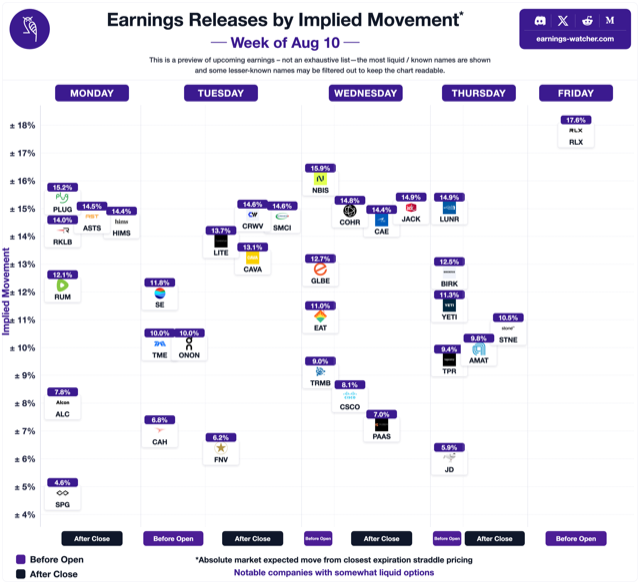
- vs the implied move: the rush is why the implied move widens into earnings — higher IV means a bigger expected move priced in.
- vs realized/actual move: the crush happens regardless of direction; whether the trade works also depends on how the actual move compares to what was priced in.
How EarningsWatcher shows both
EarningsWatcher models the full cycle so you don't have to read it off a chain by hand:
- IV Rush Radar models how implied volatility has historically built into past reports for a given name — the rush, quantified from history.
- The Simulator projects how any structure behaves through the report, modeling the IV crush per strike and expiration.
- Moves Analyser puts the implied move next to a stock's history of actual earnings moves.
Frequently asked questions
What is the difference between IV rush and IV crush?
IV rush is the rise in an option's implied volatility in the days and weeks before an earnings report, as uncertainty about the result builds. IV crush is the sharp drop in implied volatility right after the report, once that uncertainty is resolved. They are the two halves of the same earnings-volatility cycle: IV inflates into the event and deflates after it.
Do IV rush and IV crush happen to the same option?
Yes. A single option that exists through an earnings cycle typically experiences both: its implied volatility is bid up during the rush before the report, then collapses during the crush on the first session after. Both move the option's extrinsic value through its vega (sensitivity to volatility).
Why does implied volatility rise before earnings and fall after?
An earnings report is a scheduled unknown. Before it, the market does not know the result, so options carry extra premium for the possible move and implied volatility rises. Once results are released, the uncertainty is gone, so that extra premium is no longer justified and implied volatility falls back toward its normal level.
Is IV rush the same as a volatility expansion?
IV rush is a specific, event-driven volatility expansion tied to a known upcoming catalyst such as earnings. General volatility expansion can happen for many reasons (macro news, selloffs); the IV rush is the predictable build-up ahead of a scheduled report, which is why it is usually followed by an IV crush once the report is out.
This article is educational and does not constitute financial advice. Options involve risk and are not suitable for every investor.