
Holding a long option over an earnings report feels like the obvious way to bet on a big move. The problem is that the options market already knows earnings are coming and has priced a large move in. Two forces work against you the moment the report drops: IV crush and the implied move.
The two forces working against a long option
1. IV crush
Implied volatility is elevated going into the report and collapses immediately after. That collapse deflates the extrinsic value of every option — so a long call or put can lose value even if the stock moves your way.
2. The implied move
The price you pay already bakes in an expected move (the implied move). To profit on a long option, the actual move must beat the implied move — an average-sized reaction usually isn’t enough.
So when does holding through make sense?
- Your analysis says the move will beat the implied move. If a stock’s history shows it routinely moves more than what’s priced in, a long straddle/strangle can have an edge.
- You reduce crush exposure. Defined-risk structures (inverse butterfly) or a further-dated expiration soften the IV hit.
- You’re short premium on purpose. If you want the crush, holding a defined-risk condor or butterfly through the report is the whole point.
When it usually doesn’t
- Buying a plain ATM call/put “to play earnings” with no edge on the implied move — you’re paying peak IV right before the crush.
- Holding a position that needs a huge move just to break even on a name that rarely delivers one.
What has to happen for it to pay
The arithmetic is unforgiving, and it is worth doing once rather than discovering it after a print.
Suppose a stock trades at $100 and the options market prices a ±8% move — the at-the-money call and put together cost roughly $8. Buy the call alone for about $4 and your break-even at expiry is $104, so the stock has to close up more than 4%. That part is intuitive. The part that surprises people is what happens to the option before expiry: with the event resolved, implied volatility collapses, and the extrinsic value you paid for goes with it. A stock that rises 3% on the print can leave a long call worth less than it cost, because the move was real but smaller than the one already paid for.
That is why the honest question is never "will it move?" — it is "will it move more than the amount already priced in, and soon enough that the volatility collapse does not eat the gain first?"
How to check it for a specific stock
This is answerable rather than a matter of opinion. For any covered name you can compare, report by report, the move the options market implied beforehand against the move that actually printed:
- The per-ticker implied-move pages carry ten years of implied-versus-actual history, so you can see whether a stock has tended to exceed or fall short of its priced move.
- The implied-vs-actual tracker keeps the running record for the current season, including the reports that landed inside the implied move.
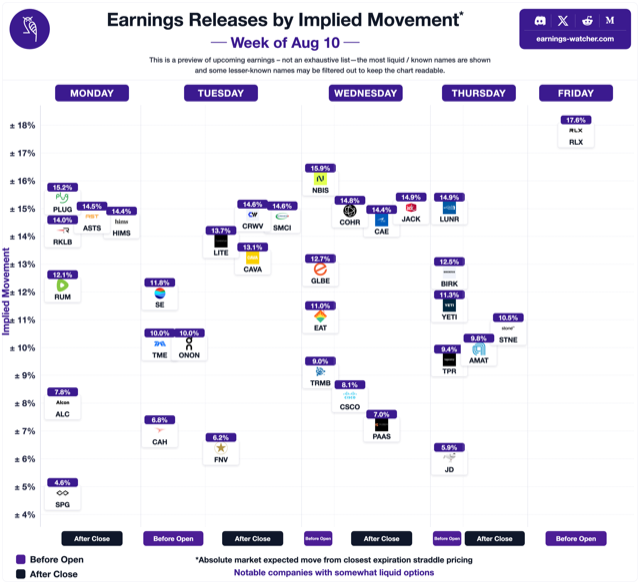
- The weekly card shows what is priced for the names reporting next.
A name whose reports routinely print larger than the implied move is a different proposition from one where the priced move is rarely beaten — and that difference is measurable before you take a position, not after.
If you want the event without the crush
Holding a long option through the report is only one way to trade an earnings event, and it is the one most exposed to the volatility collapse.
- Trade the run-up instead. Implied volatility usually rises into a report; that expansion can be exited before the print, which sidesteps the crush entirely.
- Be on the other side of it. Defined-risk short-premium structures — condors and butterflies — treat the collapse as the source of return rather than the hazard.
- Trade a peer instead. A company's closest comparables often reprice on its results while carrying no event premium of their own.
None of these is safer in the sense of risking less; they simply put the volatility collapse on your side of the trade instead of against it. Our Risk Disclosure sets out what can go wrong with each.
Frequently asked questions
Should you hold call options through earnings?
Often not. A long call held through earnings faces IV crush, so even a favorable move can lose money if it does not beat the implied move. Holding through only makes sense when you expect a move materially larger than what the options are pricing in.
Why do options lose value after earnings even when I'm right on direction?
Because of IV crush. Implied volatility collapses once the report is out, deflating the option's extrinsic value. If the stock's actual move is smaller than the implied move that was priced in, a long option can lose money despite moving your way.
When does it make sense to hold options through earnings?
When your analysis suggests the actual move will exceed the implied move, and ideally when you use a structure that reduces IV crush exposure, such as a defined-risk spread or buying a further-dated expiration. Otherwise, exiting before the report (an IV Rush trade) avoids the crush entirely.