If you are new to options, take your time learning and paper trading first. Earnings plays combine event risk, implied volatility, and gap moves — they are powerful but not something to rush into.
Options strategies around earnings have been studied for decades. The common theme: you almost never know the direction of the move, but you can often say something intelligent about how big the move is likely to be and how options are pricing that risk.
EarningsWatcher pushes this idea further. Instead of just eyeballing a few past reports, we slice 10+ years of earnings data, volatility and options pricing to highlight situations where the stats and the current implied move don’t quite line up.
How EarningsWatcher Picks Earnings Setups
The tools on EarningsWatcher are built to help you answer a few core questions around an earnings event:
- Before the release: is implied volatility likely to rise enough (IV rush) to beat theta?
- On the day of the release: is the stock more likely to move more or less than its typical earnings move?
- After the release: is the stock more likely to trend (runner) or fade (reverser)?
Under the hood we look at multiple data points, not a single magic number:
- Distributions of past earnings-day moves (mean, standard deviation, tails)
- Current vs historical implied move from options pricing
- Volatility term structure and IV crush behaviour
- Liquidity, gaps, and how a ticker typically behaves around earnings
The result isn’t a black-box “buy this now” signal. What you actually see are data-driven labels and filters — e.g. names where the implied move looks rich or cheap vs history, or where moves tend to trend or mean-revert — so you can then build and size your own trades.
Pre-Release: IV Rush Setups

The first category is pre-earnings: IV rush. Into an earnings date, implied volatility for the near-term expiration often climbs as the market prices the upcoming gap risk. Once earnings drop, that extra “event” premium collapses.
The tricky part is that IV is fighting theta decay. If you get in too early, time decay can eat the position even if IV eventually rises.
How we think about IV rush
Conceptually, you can think of observed volatility as:
- a “normal” background volatility component, and
- an “earnings” component tied to the specific event.
On EarningsWatcher, we look for situations where that earnings component has historically expanded into the event and where the current setup (calendar, stock, volatility) suggests a similar pattern is likely again. Those are the names that show up on IV Rush Radar.
Example: NFLX IV rush
In the week of a March earnings release for Netflix, the data flagged a strong IV rush candidate: IV opened the day around ~113% and ended the session closer to ~135% into the close. That IV expansion lifted the price of the closest-expiration straddle and produced roughly a +6% gain for a same-day IV rush trade.
Typical IV rush structure
- Trade the closest expiration (where the event IV is concentrated).
- Enter during the day (often after the open), exit before the close, before earnings.
- Common structure: ATM straddle; sometimes a tight strangle.
IV rush is usually a low-risk, low-reward type of setup. In practice, +5% to +10% on the position is already a good outcome. The point is not to swing for 200% — it’s to steadily harvest pre-event repricing when the stats say it’s reasonable.
Day-of-Release: Movers vs Non-Movers
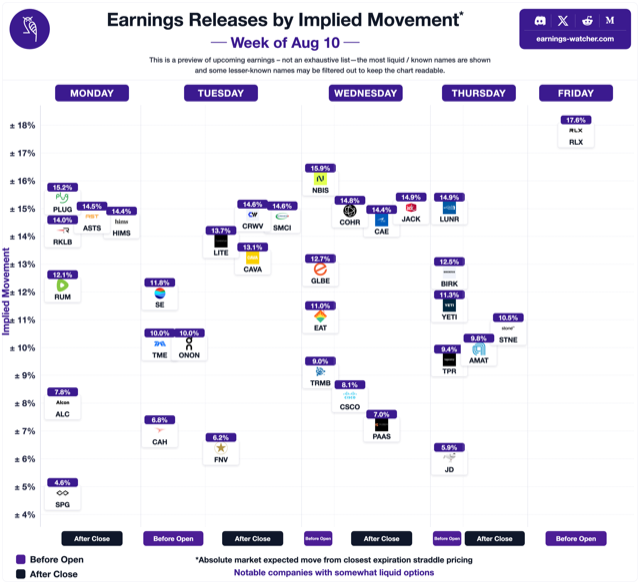
On earnings day, options price in an implied move: the % range the market expects the stock to land in after the report. It’s usually close to the average historical earnings move, but not always.
The approach on EarningsWatcher is direction-agnostic. Instead of “up or down?” we ask:
- “Is this setup more likely to move more than usual?” → we tag it as a mover, or
- “More likely to stay within its usual range?” → it leans non-mover.
Example: ADI as a mover
For one Analog Devices (ADI) earnings:
- Average past earnings move ≈ 3.9%
- Standard deviation of moves ≈ 1.5%
Looking at the distribution of past moves, ADI had a decent history of beating that 3.9% mark in similar conditions, so it landed in the “mover” bucket for that week. The next step is to compare that historical behaviour to the current implied move.
At the time, the closest-expiration straddle was implying a move of about 3.2% — slightly lower than the 3.9% historical average. For a long-volatility trade (betting the move will beat history), that’s favourable: options are pricing less than what history suggests is realistic.
A typical execution here is:
- ADI reports BMO (before market open) on day D.
- Enter the position before the close on day D-1 (the previous session).
- Use an ATM straddle or calibrated long-vol structure around the stock price at entry.
Overvalued vs Undervalued Earnings Setups
Sometimes it’s not just “mover vs non-mover” — it’s that the implied move itself looks off relative to history. EarningsWatcher tags some setups as overvalued or undervalued based on simple relationships like:
- How the current implied move compares to the average and distribution of past moves
- Whether the ticker tends to overshoot or undershoot its implied move
Undervalued cases
An undervalued setup is typically:
- The stock has a history of large earnings moves, and
- The current implied move is lower than that history suggests is normal.
Example: one JNJ earnings in March:
- Average historical move ≈ 3.4%
- Closest-expiration straddle implied only about 2.4% move
JNJ ended up moving around 4% the day after earnings, producing ~+60% on a well-calibrated straddle with 177 strikes. That’s exactly the kind of pattern the “undervalued long-vol” tag is meant to highlight: implied < history, and the realized move ends up closer to the historical distribution.
Overvalued cases
An overvalued setup is the mirror:
- The stock usually stays inside a modest range on earnings, but
- The current implied move is much larger than that historical average.
Example: one ALK earnings:
- Average past move ≈ ±6.3%
- Implied move via closest-expiration straddle ≈ ±10%
Here, the market is effectively charging “10% move” prices for something that has historically moved closer to 6%. That’s the kind of case that gets tagged as a potential defined-risk short-volatility opportunity (iron butterflies, inverse condors), not naked short straddles.
Post-Release: Runners and Reversers
The third pillar is what happens after earnings — the post-earnings drift piece. Some stocks tend to trend in the direction of the earnings reaction for days; others often mean-revert quickly.
Runners
Runners are stocks where the historical data and recent action both point to follow-through after the earnings move: the initial reaction doesn’t exhaust the move.
Example: WIX in a May earnings week came up as a runner with an expected duration of about 1.6 days after its BMO release:
- WIX reports before market open on Monday.
- Past behaviour and current tape suggested continuation from Monday’s open roughly into mid-day Tuesday.
- Classic play: a simple call or put (or debit spread) in the direction of the initial reaction.
Reversers
Reversers are the opposite: stocks that, historically, have a tendency to fade the first move on earnings and snap back. On EarningsWatcher, you’ll see that behaviour reflected in the post-earnings drift stats so you can plan for potential mean-reversion trades if the same pattern starts to show up again.
How to Actually Use These Insights on EarningsWatcher
Inside the platform, these ideas show up as screeners and dashboards, not raw theories:
- IV Rush Radar highlights names where pre-earnings IV has often outpaced theta.
- Moves Analyser shows distributions of past earnings moves and implied vs realized moves.
- Simulator models IV crush and P/L for specific structures through the event.
- DriftLab visualizes post-earnings drift and runner/reverser behaviour.
The point is not “blindly take every signal”. The point is to:
- Use data to decide whether a setup is worth considering.
- Calibrate strikes, expirations and sizing with realistic scenarios, not hope.
- Treat earnings as a repeatable game rather than a one-off lotto ticket.