
The calculation, step by step
For one expiration date, take every strike and ask: if the stock settled exactly here, what would all open contracts collectively pay out? Each open call pays its intrinsic value if the settlement is above its strike; each open put pays if the settlement is below. Multiply every contract's intrinsic value by its open interest, sum across the whole chain, and repeat for each candidate price. The strike with the smallest total payout is the max pain point — the settlement that transfers the least money from option sellers to option buyers.
A worked example (illustrative numbers)
Say a stock trades near $100 and one expiration has this open interest — a simplified chain to make the arithmetic visible, not live market data:
| Strike | Call OI | Put OI | Total payout if stock settles here |
|---|---|---|---|
| $95 | 2,000 | 6,000 | $3.1M |
| $100 | 5,000 | 5,000 | $1.9M — max pain |
| $105 | 7,000 | 2,500 | $2.8M |
| $110 | 9,000 | 1,000 | $4.6M |
Settling at $100 would leave the fewest contracts in the money, so $100 is max pain. Note what drives it: the distribution of open interest, not any view on the company. When traders pile into out-of-the-money calls, max pain sits below the crowd's strikes; the calculation is mechanical.
Why it sometimes works — and when it does not
On quiet expiration days there is a real, documented tendency for stocks to pin near strikes with heavy open interest. The usual explanation is dealer hedging: as expiration approaches, market makers' hedge adjustments push in ways that dampen movement near big strikes. Max pain often lands near those strikes, so the theory picks up genuine signal from the same mechanics.
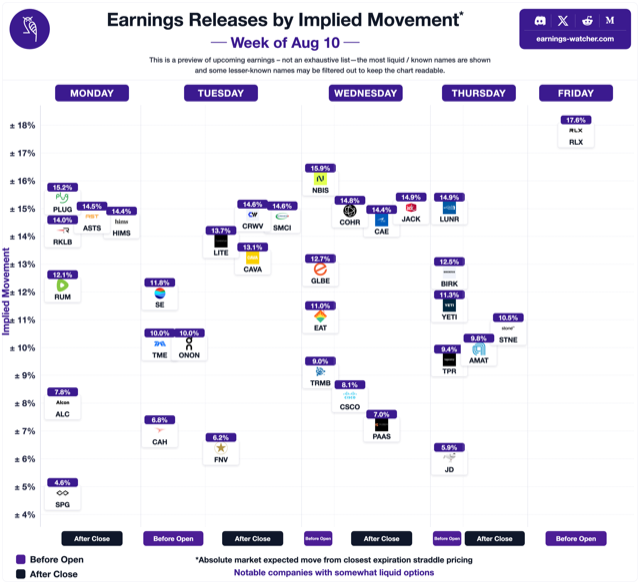
It stops working the moment real information arrives. An earnings report is a scheduled information shock: the options market prices an expected move for it (the implied move), and actual reactions regularly run several times any max-pain gravitational pull. Tapestry fell −20.2% against a ±8.9% implied move this week; no open-interest arithmetic was going to hold that stock near a strike. Around earnings, the implied move is the anchor, not max pain — and the interesting question becomes whether the stock beats what the options priced in, which is what our implied-vs-actual tracker measures all season.
Using it sensibly
Where max pain earns a place: a quick read on where option sellers are best served into a quiet weekly expiration, and context for why a stock feels sticky near a round strike. Where it misleads: as a price target through an earnings date, or on any name where a catalyst outweighs hedging flows. If you are researching an earnings name, start from what the options market prices for the event — the expected move — and its IV crush after the print, then judge whether history says that pricing runs hot or cold.
Frequently asked questions
What is max pain in options?
The strike where the total value of open calls and puts expiring in the money is smallest — the settlement price that costs option buyers the most and option sellers the least.
How is max pain calculated?
Sum the open-interest-weighted intrinsic payouts of every contract at each candidate settlement price; the strike with the smallest sum is max pain. It shifts as open interest changes, so it is recomputed daily.
Does the stock really get pinned to max pain?
Sometimes, on quiet expirations, via dealer-hedging mechanics near heavy strikes. The effect is real but small — and routinely overwhelmed by news.
Is max pain useful for earnings trades?
Rarely. Earnings reactions are priced as the implied move and frequently exceed it; max pain has no mechanism to contain a scheduled information shock.