
Earnings season is the recurring stretch each quarter when most publicly traded companies report results. The Q2 2026 season — covering April–June results — kicks off Monday, July 14, 2026 when the mega-cap US banks report before the open. Each season then peaks over the following couple of weeks as technology and consumer names follow.
Q1–Q4 2026 earnings season start & end dates
Reporting clusters into four predictable windows. Each season starts when the big US banks report (about two to three weeks after the quarter closes), peaks over the next couple of weeks as the mega-cap names follow, then winds down as smaller companies trail off. Exact dates shift a little each year; here are the approximate 2026 windows:
| Season | Reports for | Starts (approx.) | Peak weeks | Winds down |
|---|---|---|---|---|
| Q4 2025 / FY | Oct–Dec 2025 | Mid-January 2026 | Late Jan → early Feb | Late February |
| Q1 2026 | Jan–Mar 2026 | Mid-April 2026 | Late April | Mid-May |
| Q2 2026 | Apr–Jun 2026 | July 14, 2026 (banks BMO) | Late July | Mid-to-late August |
| Q3 2026 | Jul–Sep 2026 | Mid-October 2026 | Late October | Mid-November |
How long does earnings season last?
From the first major reports to the tail end, a season runs roughly six weeks. But the part that matters most for markets is the two-to-three-week peak when the largest, most-watched companies report within days of each other. Smaller companies keep reporting after the mega-caps are done, so the calendar thins out gradually rather than stopping all at once.
Why options volatility spikes during earnings season
Each earnings report is a scheduled unknown. In the days before the date, implied volatility climbs — the IV rush — because the market is pricing in a potentially large move. The moment results are out, that uncertainty is resolved and implied volatility collapses, the IV crush. During earnings season dozens of names go through this rush-then-crush cycle at once, which is why options activity and implied moves cluster in these weeks.
How to track earnings season
Knowing the season is one thing; knowing which names report on a given day, and how big a move the market is pricing, is what matters week to week. A couple of ways to stay on top of it:
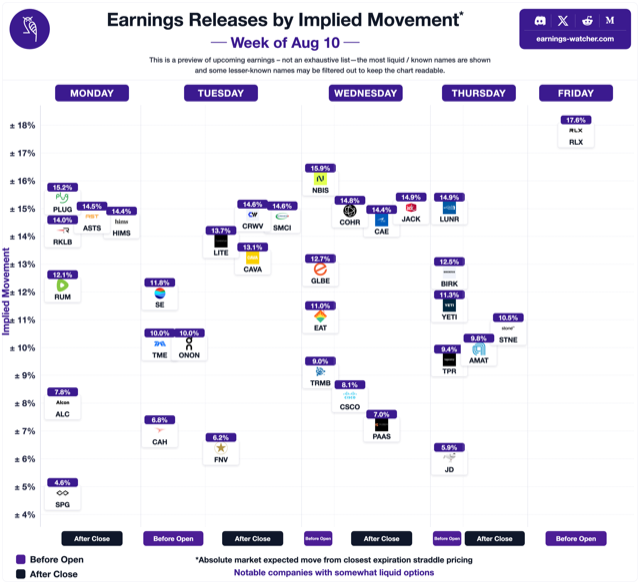
- Check the Earnings This Week page for a weekly preview of the most liquid names and their expected moves.
- Use the EarningsWatcher Calendar for the full schedule, with the implied move and volatility metrics attached to each report.
Frequently asked questions
When is earnings season?
Earnings season happens four times a year, roughly two to six weeks after each fiscal quarter ends. The main US windows are mid-January to late February, mid-April to mid-May, mid-July to mid-August, and mid-October to mid-November. Each season kicks off when the big banks report and peaks over the following two to three weeks.
How long does earnings season last?
Each earnings season lasts about six weeks from the first major reports to the tail end, but the busiest stretch is a roughly two-to-three-week peak when the largest companies report. Smaller companies continue reporting after the mega-caps are done.
Why does options volatility rise during earnings season?
Each earnings report is a scheduled unknown, so implied volatility builds into the date (the IV rush) and then collapses once results are out (the IV crush). During earnings season many names go through this cycle at once, which is why options activity and implied moves cluster in these weeks.
When does Q2 2026 earnings season start?
The Q2 2026 reporting season — covering results for the April–June 2026 quarter — begins Monday, July 14, 2026, when JPMorgan, Bank of America, Goldman Sachs, Wells Fargo and Citigroup report before the market open. It peaks in late July as mega-cap technology names follow and winds down by mid-to-late August. The quarter ended June 30, 2026; the reporting season for those results runs through July and August. Confirm each name on a live earnings calendar.
When do bank stocks report Q2 2026 earnings?
The five largest US banks — JPMorgan, Bank of America, Goldman Sachs, Wells Fargo and Citigroup — are scheduled to report Q2 2026 results on Monday, July 14, 2026, before the market open. See the bank earnings calendar for implied moves and per-bank history.
When does Q3 2026 earnings season start?
The Q3 2026 reporting season typically begins around mid-October 2026 and runs into mid-November, covering results for the July–September 2026 quarter. As with every season, the big banks report first and the mega-caps follow over the next couple of weeks; exact dates vary by company.
This article is educational and does not constitute financial advice. Reporting windows are typical ranges and vary year to year; always confirm specific dates on a live calendar.