
Earnings is one of the most researched events in options — and one of the easiest to misread if you skip the basics. The checklist below is what experienced traders look at before forming a view. It does not tell you what to trade; it tells you what data to gather.
1. Confirm the date and session
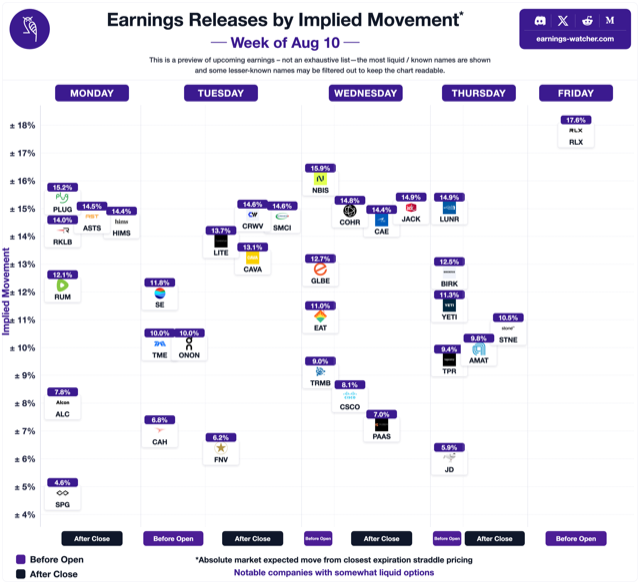
Start with the earnings date and whether the company reports BMO (before market open) or AMC (after market close). That determines when the stock reacts and which option expiration spans the event. Dates are added to calendars as companies confirm — typically within three weeks of the report. Use a live source like the weekly earnings calendar rather than guessing from last year's pattern.
2. Check the live implied move
The implied move is what options are pricing for the report — usually derived from the ATM straddle on the earnings expiration. It is the single most important forward-looking number. See how to calculate the implied move for the straddle method, or pull the live figure from EarningsWatcher's Calendar.
3. Review historical earnings moves
Compare the implied move to how the stock actually moved on past earnings days. Look at:
- Average move (typically the peak intraday move on the reaction day).
- Median and distribution — half of reports may land well inside the average.
- Tail risk — the 95th-percentile move shows worst-case outliers.
- Beat rate — how often the actual move exceeded the implied move.
Every stock has its own personality. A mega-cap that averages plus or minus 5% is a different research problem from a name that averages plus or minus 12% with fat tails.
4. Note IV context going in
Is implied volatility elevated relative to its own recent range? That is the IV rush lens — IV building into a known catalyst. IV rank and IV percentile help you see whether current IV is high or low for that stock, which affects how much crush potential exists after the print. This is context for research, not a timing signal.
What this checklist does not do
- It does not recommend buying straddles, selling premium or any specific structure.
- It does not predict whether the stock will beat or miss the implied move.
- It does not replace position sizing, risk limits or your own calibration.
Different traders use the same data for different approaches — IV rush, long vol, short vol, post-earnings drift. The data is shared; the strategy choice is yours.
Common mistakes before earnings
- Trading on an unconfirmed date. Implied moves on the wrong expiration are meaningless.
- Using last quarter's implied move as today's. IV changes daily.
- Ignoring BMO vs AMC timing. It affects which options expire into the event.
- Skipping the distribution. Averages hide tail risk; one outlier quarter can dominate P&L.
How EarningsWatcher helps
The Calendar confirms dates and shows live implied moves. The Moves analyser puts implied next to historical moves, beat rate and tails. IV Rush Radar tracks the pre-earnings IV build-up. The Simulator lets you test how a position would have behaved across past earnings — research only, not a recommendation.
Frequently asked questions
What should I check in options before an earnings report?
Confirm the earnings date and whether the company reports before the open (BMO) or after the close (AMC) — that determines when the stock reacts. Check the live implied move on the earnings expiration. Review the stock's historical earnings-move distribution (average, median, tail). Note whether implied volatility has been rising into the report (IV rush context). All of this is research, not a signal to trade.
When does the implied move become reliable before earnings?
The implied move only firms up in the one to two weeks before a confirmed report, when liquidity concentrates on the earnings expiration. Far in advance, the figure is not meaningful. Check a live calendar as the date approaches.
Should I compare the implied move to the average earnings move?
Yes — that comparison is central to earnings-options research. If the implied move is well above the historical average, options are pricing a larger reaction than usual. If it is below, they are pricing a smaller one. Neither outcome tells you what will happen; it tells you what the market expects relative to history.
Is rising IV before earnings always an IV rush?
Rising implied volatility into a confirmed earnings date is the typical IV rush pattern. But IV can rise for other reasons too (macro news, sector moves). Context matters: a rise on the earnings expiration into a known report date is the classic rush; a broad-market spike is something else.
This article is educational and does not constitute financial advice. Options involve risk and are not suitable for every investor.