
If you search for earnings volatility, you may find accounting definitions about how much a company's profits swing quarter to quarter. For options traders, the term means something different: how implied volatility and option premiums behave in the run-up to and aftermath of an earnings report. That cycle — rush, implied move, crush — is the foundation for reading any earnings options trade.
The earnings-volatility cycle
Every scheduled report follows a familiar pattern:
- Before: implied volatility rises as the market prices in uncertainty — the IV rush.
- At the event: the stock moves; options reflect both direction and the implied move that was priced in.
- After: once results are known, implied volatility collapses — the IV crush.
Seeing earnings volatility as one connected cycle — not three unrelated concepts — is the starting point for any research workflow. For the two-sided comparison, see IV crush vs IV rush.
IV rush: volatility builds into the report
An earnings date is a scheduled unknown. The market knows when news is coming but not what it will say. Options carry extra premium for that possible move, so implied volatility climbs in the days and weeks before the print. That build-up is the IV rush. It is event-driven — tied to a known catalyst — which is why it is usually followed by a crush once the report is out.
The implied move: the market's expected range
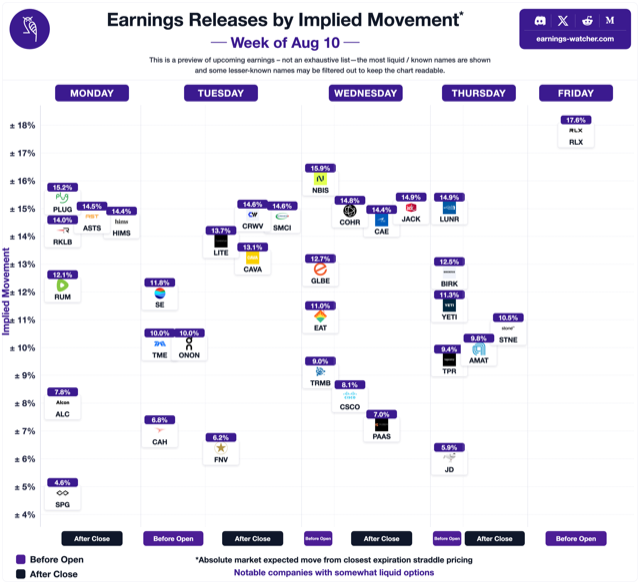
The implied move translates elevated IV into a concrete percentage range: roughly how far the options market expects the stock to move around the report. It is typically derived from the at-the-money straddle price on the earnings expiration. Compare that figure to the stock's historical earnings moves to see whether options are pricing a larger or smaller reaction than the past suggests. See how to calculate the implied move for the straddle-price method.
IV crush: volatility collapses after the print
Once earnings are released, the uncertainty that inflated IV is gone. Implied volatility drops sharply — often in the first session after the report (next day for after-close reporters). That collapse is the IV crush. It can happen even when the stock moves sharply in the "right" direction, because the options were priced for uncertainty, not just direction.
Earnings volatility vs other volatility measures
- Historical (realized) volatility looks backward at how the stock actually moved. See implied vs historical volatility.
- IV rank / IV percentile compare current IV to its own past range — a different yardstick. See IV rank vs IV percentile.
- Earnings volatility is the full event cycle: rush, implied move, crush.
Common mistakes
- Confusing accounting volatility with options volatility. Profit swings in financial statements are unrelated to the IV cycle options traders care about.
- Ignoring the crush. A correct directional guess can still lose if IV collapse outweighs the stock move on long premium.
- Using one quarter's move as the rule. The distribution of past earnings moves matters more than the last print.
- Checking implied move too early. The figure only firms up as the report nears; use a live calendar like earnings this week.
How EarningsWatcher helps
EarningsWatcher is built around earnings-volatility research: the Calendar shows live implied moves and report dates; the Moves analyser compares implied to historical earnings moves; IV Rush Radar tracks the pre-earnings build-up; and the Simulator models how IV crush affects positions. Start with the weekly calendar for names reporting soon.
Frequently asked questions
What is earnings volatility in options trading?
In options, earnings volatility refers to how implied volatility and option prices behave around a quarterly report — not the company's accounting earnings variance. Before the print, uncertainty pushes implied volatility up (the IV rush). Options price in an expected move range. After results are out, that uncertainty resolves and implied volatility usually collapses (the IV crush).
How is earnings volatility different from normal stock volatility?
Normal day-to-day volatility is diffuse and ongoing. Earnings volatility is event-driven: the market knows a scheduled catalyst is coming, so implied volatility rises into a specific date and often falls sharply once the number is released. The move is concentrated in a short window rather than spread across months.
What is the implied move in earnings volatility?
The implied move is the percentage range the options market is pricing for the stock around the report, usually derived from the at-the-money straddle price. It is the forward-looking yardstick for how much movement is expected — compare it to the stock's historical earnings moves to see whether options look rich or cheap relative to past behaviour.
What are IV rush and IV crush?
IV rush is the build-up of implied volatility in the days and weeks before earnings as uncertainty grows. IV crush is the sharp drop in implied volatility right after the report once the outcome is known. Together they form the earnings-volatility cycle that drives most options P&L around a print.
This article is educational and does not constitute financial advice. Options involve risk and are not suitable for every investor.